My Friend, Clay

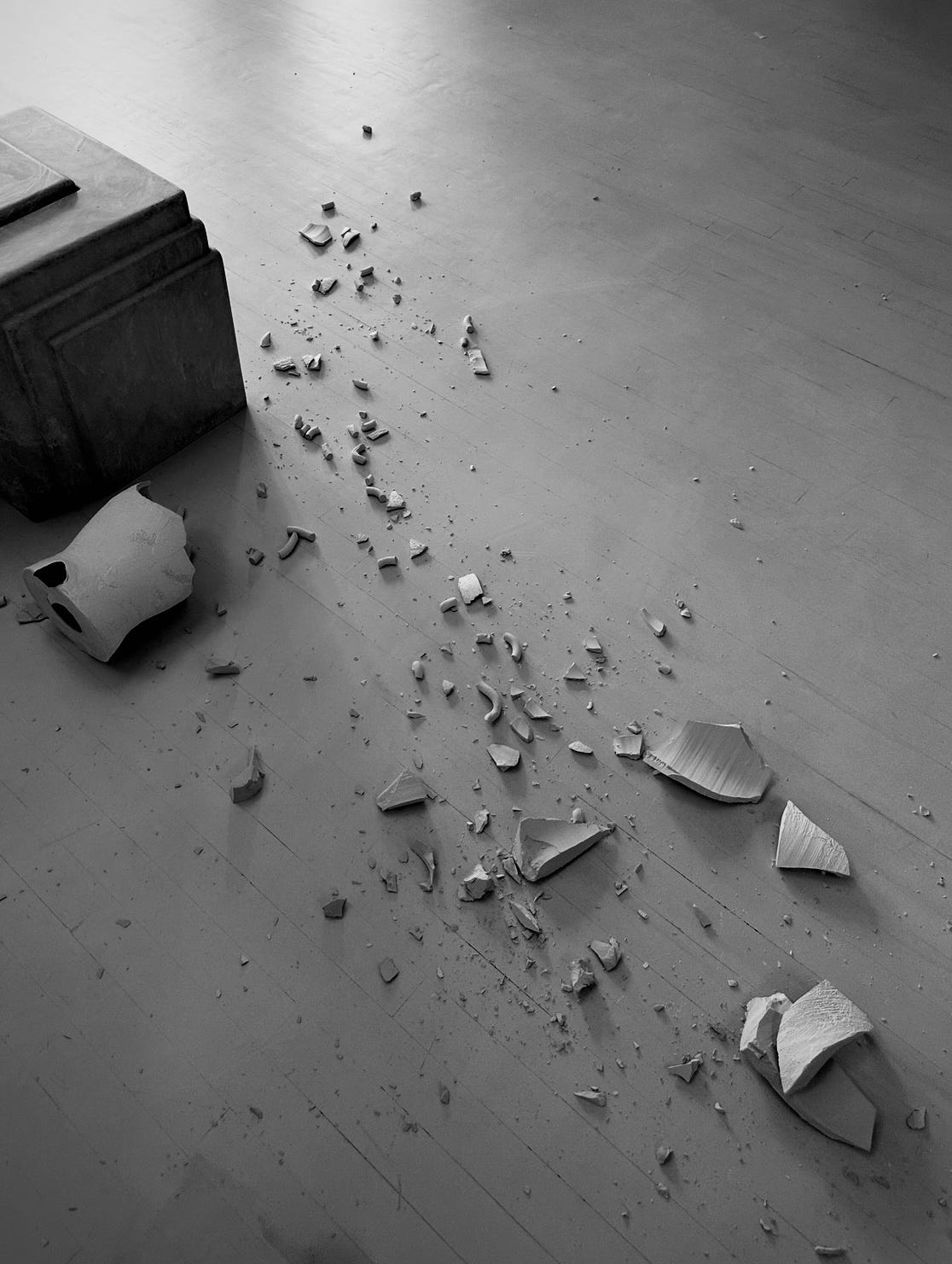
Clay entered my life as a material with its own will, asking me to meet on its terms rather than mine. We have toiled and tumbled, and though she often claims the victory, my practice has grown out of learning how to move with her stubbornness rather than against it. If paint is a dog, loyal and eager to please, clay is a cat. It keeps its mystery. It decides when to come close and when to resist. It teaches me to listen.
In my Tribeca studio, the city folds itself into the rhythm of my days. I am repetitious and methodical when it comes to certain aspects of my morning. I arrive, drop my bag and keys on the glass desk, and change into clean but paint-splattered jeans, a denim shirt, a linen split-leg smock, and white clogs. I open all eight windows, no matter the season, and let Canal Street’s eccentric personality pour into the white walls. Sporadic car horns rise at eight in the morning, fall into a lull mid-day, and build again into a crescendo at evening rush hour. In winter, steam rises from the subway station beneath my building like breath from a human mouth, the sidewalk grates its teenage braces. I sometimes film the drift, making small movies of movement and air and imagine I’m standing on a mountain peak with clouds passing around me. A pigeon lands on the sill to say hello and watches me, leaving a gift before flying away into the smog.
Across the street at the souvenir store below, rows of I heart NY t-shirts hang from the awning, dangling above rolling luggage bags chained together with bike locks. Each suitcase wears a neon-colored balaclava pulled over its handle, transforming these everyday objects into masked figures. They seem like prisoners of the shop, waiting for freedom from a sympathetic passing tourist. On the second floor of the building, the silhouettes of tai chi students move behind sheer curtains, their forms outlined against the turquoise glow of the studio’s lights. On the roof above the peaceful dancers, a broken white mannequin is draped against the aluminum siding, a quirky kind of security guard. As my eyes continue on, I notice pedestrians spilling from the narrow pizza shop on the corner, the smell of bread and oil drifting into the air. I love to be alone, yet I never truly feel alone in my studio, because the city is always alive and humming around me. Inside, the sun provides endless entertainment as it moves across the hours, pulling shadows along the walls like reels of an unfinished film. When I lift my glass of water, I pause to admire the constellation of clay fingerprints scattered across it, small traces of the conversation I have been having with my hands. I see it as a little abstract painting.
There are days when I lose myself completely in this space. The clock disappears, lunch is forgotten, and ten hours slip by unnoticed. Even having a sip of water is an interruption. It would take precious seconds to wash my hands before touching the glass. On those days I walk in early without a rigid plan, willing to follow whatever presents itself. Recently, I had stoneware extrusions left out too long. Though they had been covered, they crept into leather-hard territory and were lost to their original purpose. When clay progresses to its next stage of drying, there is no going back. Clay does not look back as it is in a constant state of metamorphosis. Instead of seeing this prep work as a casualty, I decided to use the pieces as they were. They became tubular, figure-like sculptures, forms I could not have conceived until the opportunity appeared in front of me. If I had treated the hardened clay as defeat and recycled it, those works would never have existed.
Another of clay’s chief characteristics is its refusal to be forced. There are moments when the wheel and I are one. My hands follow the spinning clay and I fall into rhythm, throwing with my eyes closed, the clay pulling me rather than the other way around. The alignment feels almost out of body, and these moments convince me I am living inside magic. And then there are days when, no matter how carefully I center, I find myself tugging at the clay and it resists me. When throwing, the left and right hands must always help one another. Even when the wall of clay lies between them, they must remain touching through the clay. If I press forward without that harmony and agreement of the clay itself, the piece does not align with me, and the energy is wrong. On those days I know to leave the wheel and return later, because the work reflects not only the material but the state of the maker.
When I work large, the stakes are higher. I build tall forms by stacking thrown sections and joining them together through another round of throwing. Then I hand-build on top of the wheel thrown work, stretching the limits of weight and gravity. A vessel may lean under its own burden, a wall may collapse after a whole day of labor. If I grab a fistful of clay and add too much before the base is strong enough, the structure buckles. Through trial and error, I know how far I can push safely, yet I find myself enjoying the risk of pushing further. I like to be a little naughty, to question the rules, to test the limits, the way I often did as a child. When the milk spills, instead of grieving those hours as lost, I laugh. Sometimes there is a flicker of disappointment as the plan dissolves, but I notice, observe, and allow it to pass quickly. What remains often points me toward something more compelling than what I had consciously conceived. Some of my favorite works, some of my breakthroughs, have begun in the ruins of collapse. Clay has taught me that risk carries its own reward, that failure can be a doorway, that fragments are not an end but a passage. Risk is the turbo-blast button on my creativity.
When I am in the process of creating a body of work, I know that some stories will be longer than others. Some pieces crack in drying, others fracture in the kiln. The ones that endure are steady companions that will outlive me, and in my mind they become immortal beings. Others stay briefly, like short friendships, precious even in their brevity. Some arrive only to teach me lessons of letting go. And some I choose to end myself, striking them with a hammer even when I cannot say exactly why, except that I know their fragments belong to another form. Later they reappear on canvas, carrying a new story I could not have written without breaking them first. Saying goodbye is a learned practice.
The kiln is the final collaborator and it is unpredictable. It hardens the clay into permanence, it fractures it, or it destroys it entirely. I do not hold the final word, or perhaps I do, because even here there is space for me. There is agency. If it breaks what I thought was almost finished, who is to say it is over? I can take those fragments and continue. What feels like an ending is often a redirection, and the turn ahead may be more beautiful than the path I thought I wanted.
Mary Caroline Richards writes in Centering in Pottery, Poetry, and the Person:
“The potter does everything he can do. But he cannot burst into flame and reach a temperature of 2300 degrees Fahrenheit for a period varying from eight hours to a week and harden plastic clay into rigid stone, and transform particles of silica and spar into flowing glaze. He cannot transmute the dull red powder that lies upon the biscuited ware into a light-responsive celadon. He can only surrender his ware to the fire, listen to it, talk to it, so that he and the fire respond to each other’s power.”
I think of this when the work leaves my hands and begins its own passage in the kiln. I lower the hood and as it creaks closed, I say a prayer. In the early days it was, “Please do not break and protect the work in this fire.” Now it has become, “Show me the way.” Once I press start on the screen and the kiln begins clicking, the temperature rising toward its first hold, the studio stills and so do I. The green-gray shadows on the wall soften into golden brown as the day comes to an end. This, too, is a point of surrender. What emerges when the kiln cools is what it was meant to be, and my task is to welcome it as part of a story still unfolding.
.